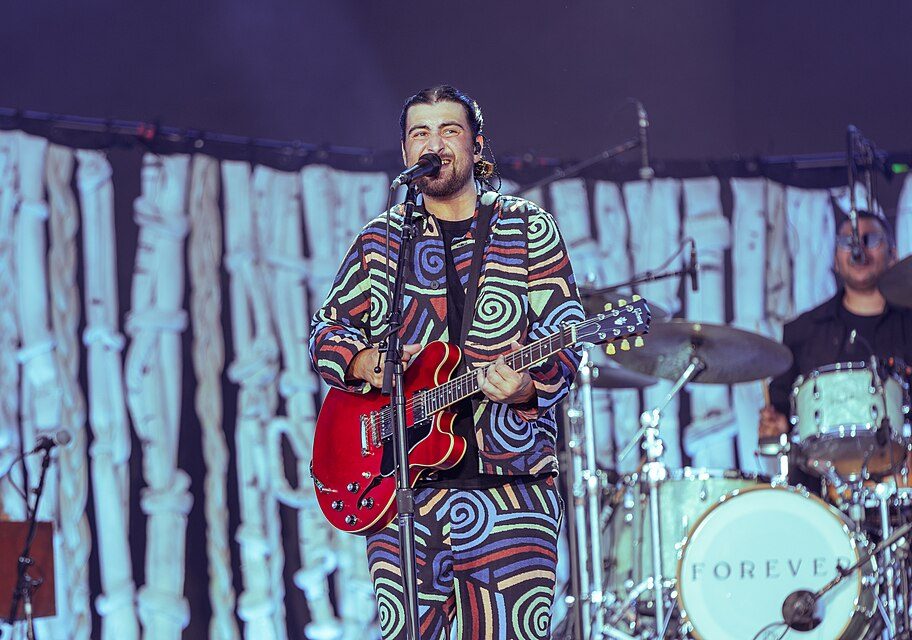
On April 24, folk artist and singer-songwriter Noah Kahan released his fourth studio album, The Great Divide. With a solid 17-set track list, Kahan artfully explores the realm of life outside his small hometown in Vermont and the nostalgia paired with guilt that comes from growing up and leaving for new horizons. The album is the perfect encompassment of living with fame, being a voice for mental health, and swaying on the boundaries of leaving behind a positive impact.
The album opens with “End of August.” Such a great opening track. The crickets are a rather fun and atmospheric little touch. The piano in the intro also sets the tone for the trajectory of the rest of the album. We know Kahan loves his home state of Vermont and this is no exception. There’s an underlying theme of mundanity and the beautiful simplicity of that; never having to worry that things may change too much. “I tried getting sober, I swear I did better this time” is a lyric that forms and folds itself into the album as a whole. The trombone in the outro adds tonal texture. It’s fun to see Kahan going outside of his box instrumentally. The end of August triggers a new season, and it seems he’s trying to tell us that this album will be new and different in the best way
As the second track opens, the album holds its bittersweet tonality while simultaneously incorporating how it feels to truly be in love with someone else as a person who struggles with overall mental health, self-image, and the fear of abandonment. “You’re the one who decided to knock,” is a common motif of the chorus and a beautiful way to express how exactly Kahan feels towards his wife. The idea of the door itself is a creative metaphor for letting someone in despite being a closed-off kind of person.
Track three, “American Cars” explores guilt and familial tension in classic Noah fashion, poetically. It could even be told from the POV of a family member who wants him to come home and yet it’s Kahan who’s writing this so it seems he’s painfully self-aware of the toll that stardom has taken on his family. A favorite lyric of mine is, “If drinking was a day job I’d be asking for more money.” I love a metaphor, but it’s also telling that maybe Kahan feels so much of life’s pressures, and that’s driven him to drinking again after a sobriety stint. THe overall theme is a profound one: “‘Cause you’re gonna fix it, you’re gonna patch it up ‘cause, honey, we’re fragile, you’ve always been so tough. You know that I miss you, you always come runnin’ back whenever I ask.”
“Downfall” comes up next. This one expands on the idea that you don’t know what you’ve got ‘til it’s gone. Lyrics like “You know you never really could quite place when I’m angry and I’m joking.” and “I’m leaning towards a subject change in a sentimental moment” could be a connection not only to an ex-lover but to Kahan’s hometown and the wrestle of having left, loving someone immensely, yet still resenting them for being gone. There’s a healthy dose of immersive and fresh storytelling that I thoroughly appreciate. “Call me when the bugs don’t die and the spring looks just like autumn” is a potential callback to “End of August” themes. We’ll see that throughout the entirety of the tracklist, one big interconnected story is told through 17 beautifully deep songs. This track specifically isn’t my favorite, but I see how others in his audience may like it.
“Paid Time Off” had a nice roll and rhythm to it that’s pretty genius when contrasted with the song’s message. I’ve found myself tapping along to the beat multiple times throughout my listens, and I think that was Kahan’s goal. He’s literally and metaphorically working for paid time off and wants to enjoy the fun parts of life, but instead, he writes, “I’m alone, getting lost in the scope of it.” It might be inferred that this song was written for a sibling. He’s eager to have another, “d*** near perfect day.” Aren’t we all?
On January 30, 2026, Kahan released a single sharing the same name as the album. While the song itself is filled with call-backs, the official music video sneaks in lots of hidden Easter eggs for intense fans, solidifying the motif of looking back on the past. The song as a whole explores themes of guilt when it comes to leaving a good friendship on bad terms while feeling powerless to do anything about it. It’s a skillful representation of growing apart and being too immature to do anything to mend the situation. I wouldn’t be surprised if the metaphorical symbolism alone would earn this song many praises and awards.
The next two tracks fall like a call and response on the ears. “Haircut,” a song that begins abruptly, bleeding with raw, classic Noah Kahan lyricism and emotion, seems to take the perspective of an outsider, looking in with disapproval of Kahan’s career and willingness to abandon his hometown. It feels whimsical and less formal overall, while still embodying feelings of guilt. “Willing and Able,” or the responding song, has a very different tonality, full of shaky vocals similar to those found on tracks of I Was/ I am. The double meaning of being willing and able is shown from the beginning; first, Kahan was the only one truly willing to pack his bags and leave his hometown. Additionally, this song seems to be addressing the harshness Kahan has displayed in the previous tracks. He claims, “I’d be willing and able. If you’re willing, I’m able” to reconcile the tarnished relationships he’s left behind.
There’s a similar theme of accepting an outside perspective as the album continues into “Dashboard.” The intro chords fell nicely on the ears; the whole song did, really. The lyricism reflects a sense of self-awareness and a more negative way of talking about himself. As the listener, you almost feel as if Kahan is speaking to an outsider but the outsider is himself. It’s a creative take that I honestly appreciate.
“23,” is such a complex story and painfully relatable to not just me, but I feel for many others as well. The idea here is that 23 was the year before/when addiction stole someone he loved and that makes him feel SO many conflicting emotions. Loving an addict is indescribable, but here Kahan tries. “Even when you’re not here, it becomes about you.” is a sad but true sentiment. There are so many lines in this song that I love, but “Lifting the weight of you off my mind. ‘Cause if I never see you again, you could be anything I want.” speaks volumes. Anyone who’s ever loved an addict likely has this vision of either what they used to be, what they could be, or both , before the bottle broke them. If we never see them drunk or high, then we can choose to remember them sober. But for now please, “Stay gone, stay gone”
The following song takes another twist. I couldn’t help but imagine the perspective being a maternal one, angry at her son for leaving. “Porch Light,” metaphorically encompasses the pain that comes from waiting for someone to come back to you. Musically speaking this song has a lot going for it as well. The banjo near the end of the song had an edge to it that really pulled the whole song together. Similarly, “Deny, Deny, Deny,” was probably my favorite based on sound alone. From the beginning, the song starts off strong. It’s passionate and full of feeling.
“Headed North” brings the crickets back!! He opens the song with a silly little adlib that shows us a bit of his personality, which I love. The acoustic guitar is aggressive and creative as well. “If I see one more cyber truck, I swear to God I’m gonna floor it.” REAL KING! The overall theme of this one seems to be of missing a friend and heading back home to Vermont to ground himself. With this song, Kahan proves that he’s multifaceted and not just a sad boy. If you ever wondered, he’s “bored and headed north.”
With track 14, “We Go Way Back,” Kahan delves into his own mental health struggles. “I can’t make myself whole. Most days, I’d be lucky just to get half. But you’ve seen me in places so low, you can recognize when it’s real bad.” The “you” here could be his wife. The idea of that is precious. I think this song is a nod of thank you to his wife for helping him get through a difficult season. The backing female vocals are a creative touch. Stick Season was immensely successful and Kahan has talked publicly about the pressure to meet expectations. “I can hear the song of the robin, I haven’t wrote my own in a long time” is a line that communicates that idea so poetically. His apology track for “the late flights and missed birthdays” is one of my favorites
“Spoiled” began to circle the album back with call backs to other songs, including from this album. However, it begins to explore Kahan’s life as he thinks of starting a family. There’s a light trumpet section in the background, adding to the tone. Kahan expresses his knowledge of his bad habits. He sings, “Tell the fellas at the morgue that I’m headed back on tour” and “They’ll say, “I wanna be you, but I don’t wanna be that.”’ He’s a work-a-holic that struggles with fame, and he admits it.
“All Them Horses,” holds a similar theme, but this time the melody is soft and purely melancholy. Kahan perfectly captivates the guilty feeling of never coming home by describing the scene from a devastating floods in Vermont during 2023. ““I crossed the county line, I cannot go back. I’m always on my own. Couldn’t make it home ’cause of all that rain,” he sings.
The final track, “Dan,” is a lovely way to end. A ballad to a long-time friend, who, despite the rockiness, the troubles of fame, disagreements, and differences, will be there to sit down and be there for you, is what Kahan sings about. He also references Carlo Keep and his tragic death, expressing on the growth and reflections that have led him back to the debut album where it all began. This song perfectly wraps the whole thing together, ending on a wholesome note, filled with themes of compassion and love.
Well friends, Kahan’s done it again. We agree that the Great Divide is definitely a bop. Classic folk techniques and deep-cutting lines are present, but so is heart, authenticity, and a fresh perspective on where Kahan is at mentally. Fame, fortune, and complicated family dynamics make for a banger of an album.